Population modelling
Estimating how many people of each age live in each 5 km grid cell, using survey data and spatial models where census microdata are missing or out of date.
Population modelling
Estimating how many people of each age live in each 5 km grid cell, using survey data and spatial models where census microdata are missing or out of date.
To calculate vaccination coverage or disease rates, programmes need to know how many people of the relevant age live in each area. Censuses are infrequent and often lack local detail. Household surveys such as DHS and MICS are not designed to estimate populations in small areas. Most fine-scale population models give totals or broad age groups, such as under-fives.
I wrote and maintain AgePopDenom, including the model code, download helpers and country workflow. I co-wrote jollofR with Chibuzor Christopher Nnanatu and colleagues at WorldPop, University of Southampton. I am also a co-author of the methods paper on parameter-based geostatistical prediction of age-structures, which is under review.
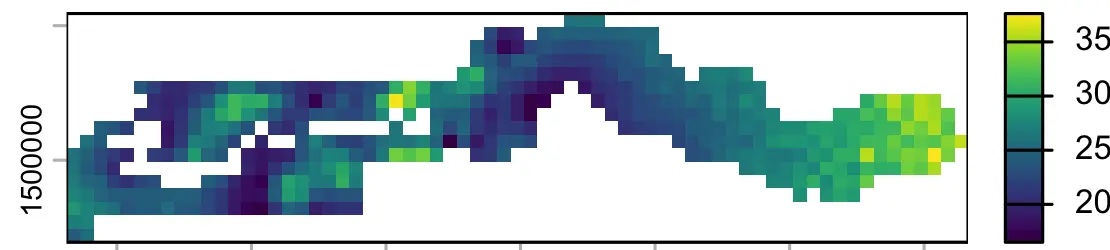
AgePopDenom estimates population by single year of age on a 5 km grid, with uncertainty, using openly available data. It is on CRAN. I was lead author of the paper describing it in the Journal of Open Source Software. jollofR, also on CRAN, disaggregates small-area population totals into age, sex or other demographic groups.